
Examples / TI op amp handbook / AC amplifiers
Double rolloff
SBOA092B page 77, Double Rolloff: EI through C2 1 µF onto the + input; R0 90 kΩ from the output to the - input; C1 100 µF from the - input down to a junction, R1 10 kΩ from the junction to ground, and R2 100 kΩ from the + input to the same junction, so that R2 is bootstrapped.
"Similar to above." C_1 R_1 = C_2 R_2The circuit
Section titled “The circuit”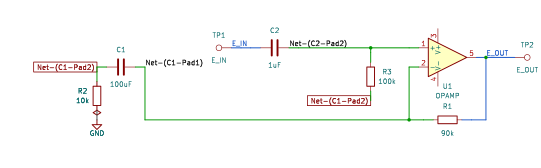
The schematic is drawn by copperhead’s
drafting engine from this circuit’s netlist, with KiCad’s own library symbols,
and it opens in KiCad as figure/double_rolloff.kicad_sch.
The op amp is KiCad’s generic one, since the handbook’s are ideal, and each
terminal is a test point named as the program names it. KiCad reads back from
the sheet exactly the connections the circuit has; draw_figures.py refuses to write
one that does not.
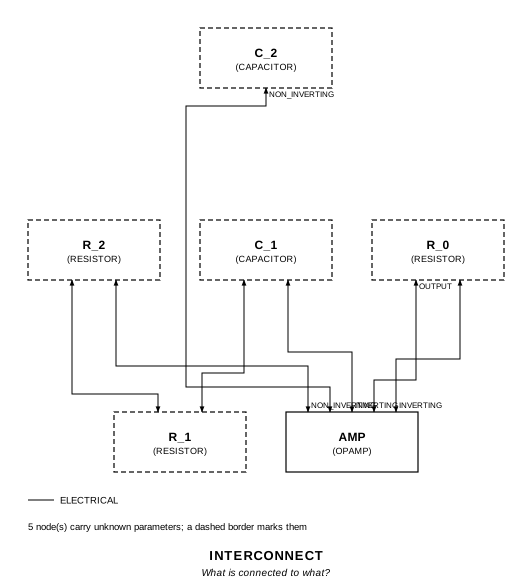
The interconnect view is fang’s own projection. It names the parts as the program does, so it reads against the code below.
What the program says
Section titled “What the program says”topology records the reading of the wiring: R_2 returns to the C_1 R_1
junction, not to ground. Solving the three nodes (response) gives
E_O / E_I = s T_2 (1 + R_1/R_2 + s (R_0 + R_1) C_1) / (s^2 T_1 T_2 + s T_2 (1 + R_1/R_2) + 1)with T_1 = R_1 C_1 and T_2 = R_2 C_2: 10 in the midband, 40 dB per decade
below the poles, back to 20 dB per decade below a zero at 17.5 mHz. The drawn
values give T_1 = 1 s and T_2 = 0.1 s, so the page’s rule does not hold.
reading keeps the drawn values, and the parameters t_1 and t_2 say
what they are, with a constraint that T_1 is ten times T_2.
What the simulation found
Section titled “What the simulation found”| Run | Measured | Claimed |
|---|---|---|
response, gain at 1 kHz | 10 | 10 (a_v), holds |
response, peak gain | 29.21 (+9.3 dB) | 29.21, holds |
response, slope 0.05 to 0.15 Hz | 40.5 dB/decade | 40 ±1, holds |
response, slope 1 to 10 mHz | 21.2 dB/decade | 20 ±1.5, holds |
response, -3 dB point | 0.331 Hz | not a claim |
dc, E_O with E_I = 1 V d.c. | 0 V | 0 V, holds |
The rolloff is double, as the title says, but with T_1 ten times T_2 the poles have a Q of 2.9 and the response peaks 9.3 dB above the midband near 0.52 Hz.
Where the handbook is off
Section titled “Where the handbook is off”The rule C_1 R_1 = C_2 R_2 is printed beside values that break it: 100 µF x 10 kΩ is 1 s, 1 µF x 100 kΩ is 0.1 s. With the rule met (C_2 = 10 µF, say) the Q falls to 0.91 and the peak to 0.8 dB.
Running it
Section titled “Running it”fang check examples/ti_opamp_handbook/ac_amplifiers/double_rolloff/double_rolloff.pypython examples/regenerate.py ti_opamp_handbook/ac_amplifiers/double_rolloff # needs ngspiceThe whole program
Section titled “The whole program”"""The double-rolloff a.c. amplifier, SBOA092B page 77.Show 26 more lines
"Similar to above." C_1 R_1 = C_2 R_2
The non-inverting a.c. amplifier above it, rearranged. E_I reaches the +input through C_2. R_0 (90 kOhm) runs from the output to the - input, C_1(100 uF) from the - input down to a junction, and R_1 (10 kOhm) from thatjunction to ground. R_2 (100 kOhm) returns the + input to the same junctioninstead of to ground. In the midband C_1 is a short, the junction follows the- input, which follows the + input, so almost no signal current flows in R_2:it is bootstrapped, and the input network no longer rolls off on its own. Thetwo RC pairs then act together, and the response below the midband falls at40 dB per decade instead of 20.
Solving the three nodes with an ideal op amp gives
E_O / E_I = s T_2 (1 + R_1/R_2 + s (R_0 + R_1) C_1) / (s^2 T_1 T_2 + s T_2 (1 + R_1/R_2) + 1)
with T_1 = R_1 C_1 and T_2 = R_2 C_2. The page's rule, C_1 R_1 = C_2 R_2, isnot met by the values it draws: T_1 = 100u x 10k = 1 s, T_2 = 1u x 100k =0.1 s. With T_1 ten times T_2 the denominator's Q is sqrt(T_1 T_2) /(T_2 (1 + R_1/R_2)) = 2.9, and the response peaks 9.3 dB above the midbandnear 0.52 Hz. The program keeps the drawn values (`reading`) and the benchmeasures what they do. With equal time constants (C_2 = 10 uF, say) the Q is0.91 and the peak under 1 dB."""
import sysfrom pathlib import Path
# The handbook's shared parts and bench live in the folder above the sections.sys.path.insert(0, str(Path(__file__).resolve().parents[2]))
from fang.lang import Parameter, System, kOhm, require, s, uFfrom fang.parts import Capacitor, Resistorfrom fang.rationale import Calculates, Chooses, Citesfrom fang.simulation import ACSweep, OperatingPoint
from handbook import ( Bench, Claim, Ground, OpAmp, Run, Terminal, at_least, equals, over, product, ratio, total,)
class DoubleRolloff(System): """C_2 onto the + input, R_2 bootstrapped to the C_1 R_1 junction."""
figure = Cites( "Similar to above. C_1 R_1 = C_2 R_2", document="SBOA092B, Handbook of Operational Amplifier Applications", locator="page 77, Double Rolloff", )
reading = Chooses( "The drawn values give C_1 R_1 = 1 s and C_2 R_2 = 0.1 s; which does the program follow?", selected="the drawn values, and the rule is recorded as not met", alternatives=[ { "option": "change C_2 to 10 uF so that the rule holds", "reason": "the figure is the source of truth for values; the rule is the page's intent, and the gap is reported", }, ], rationale=( "the figure prints 1 uF, 100 kOhm, 100 uF and 10 kOhm", "the bench shows what the mismatch costs: a 9.3 dB peak", ), )
topology = Chooses( "Where do C_1 and R_2 connect?", selected=( "C_1 from the - input to a junction, R_1 from the junction to " "ground, and R_2 from the + input to the junction" ), alternatives=[ { "reading": "R_2 to ground, as in the circuit above", "reason": "the figure brings R_2's lower end across to the C_1 R_1 junction, not to the ground line", }, ], rationale=("the dot at the C_1 R_1 junction has R_2's wire arriving from the left",), )
response = Calculates( "E_O / E_I = s T_2 (1 + R_1/R_2 + s (R_0 + R_1) C_1) / (s^2 T_1 T_2 + s T_2 (1 + R_1/R_2) + 1)", inputs=("r_0", "r_1", "c_1", "r_2", "c_2"), result=( "10 in the midband; poles at f_0 = 1/(2 pi sqrt(T_1 T_2)) = 0.50 Hz " "with Q = 2.9, a peak of 29.2 (9.3 dB over 10) at 0.52 Hz; " "40 dB/decade below that down to the zero at 0.0175 Hz, 20 dB/decade below it" ), )
a_v = Parameter("1", default=10 * ratio, description="E_O / E_I in the midband") t_1 = Parameter("s", default=1 * s, description="R_1 C_1") t_2 = Parameter("s", default=0.1 * s, description="R_2 C_2")
e_in = Terminal() e_out = Terminal() c_2 = Capacitor(capacitance=1 * uF) r_2 = Resistor(resistance=100 * kOhm) c_1 = Capacitor(capacitance=100 * uF) r_1 = Resistor(resistance=10 * kOhm) r_0 = Resistor(resistance=90 * kOhm) amp = OpAmp() ground = Ground()
def architecture(self): self.e_in.probe >> self.c_2.p1 self.c_2.p2 >> self.amp.non_inverting.signal self.amp.non_inverting.signal >> self.r_2.p1
self.amp.inverting.signal >> self.c_1.p1 self.amp.inverting.signal >> self.r_0.p1 self.r_0.p2 >> self.amp.output.signal self.amp.output.signal >> self.e_out.probe
# The junction: C_1's lower end, R_2's return, and R_1 to ground. self.c_1.p2 >> self.r_1.p1 self.r_2.p2 >> self.r_1.p1 self.r_1.p2 >> self.ground.node
def constraints(self): require( equals( self.a_v, over(total(self.r_0.resistance, self.r_1.resistance), self.r_1.resistance), ) ) require(equals(self.t_1, product(self.r_1.resistance, self.c_1.capacitance))) require(equals(self.t_2, product(self.r_2.resistance, self.c_2.capacitance))) # Not the printed C_1 R_1 = C_2 R_2: as drawn, T_1 is ten times T_2. require(at_least(self.t_1, product(self.t_2, 10 * ratio)))
BENCH = Bench( page=77, title="Double Rolloff", runs=[ Run( "response", ACSweep(points=200, start="0.0001", stop="10meg"), drive={"e_in": "DC 0 AC 1"}, measure={ "gain_1k": "find vm({e_out.1}) at=1k", "peak": "max vm({e_out.1}) from=0.01 to=100", "g_005": "find vm({e_out.1}) at=0.05", "g_015": "find vm({e_out.1}) at=0.15", "slope_steep": "20 * log10(g_015 / g_005) / log10(3)", "g_0001": "find vm({e_out.1}) at=0.001", "g_001": "find vm({e_out.1}) at=0.01", "slope_low": "20 * log10(g_001 / g_0001)", "f_3db": "when vdb({e_out.1})=16.9897 cross=1", }, claims=[ Claim("gain_1k", "a_v", within=0.001), Claim( "peak", 29.21, within=0.005, note=( "9.3 dB above the midband, from the transfer function " "with T_1 = 1 s and T_2 = 0.1 s; the page's rule " "C_1 R_1 = C_2 R_2 would hold it under 1 dB" ), ), Claim( "slope_steep", 40, within=1, absolute=True, note="dB per decade between 0.05 Hz and 0.15 Hz: the double rolloff", ), Claim( "slope_low", 20, within=1.5, absolute=True, note=( "dB per decade from 1 mHz to 10 mHz, below the zero at " "(1 + R_1/R_2) / (2 pi (R_0 + R_1) C_1) = 17.5 mHz, " "where the response is back to a single rolloff" ), ), ], units={"f_3db": "Hz"}, note=( "The sweep has 200 points a decade so the peak, near 0.52 Hz, " "is read to better than 0.5%. The -3 dB point, where the gain " "first reaches 10 / sqrt 2 on the way up, is not a handbook claim." ), ), Run( "dc", OperatingPoint(), drive={"e_in": "DC 1"}, measure={"e_out": "v({e_out.1})"}, claims=[ Claim( "e_out", 0, within=1e-6, absolute=True, unit="V", note="C_2 blocks the 1 V; R_2 and R_1 hold the + input at ground", ) ], ), ],)The files it writes
Section titled “The files it writes”The parts, then the nets and the pads on them.
C1 100 uF -C2 1 uF -GND1 Ground -R1 90 kOhm -R2 10 kOhm -R3 100 kOhm -TP1 Terminal -TP2 Terminal -U1 OpAmp -Net-(C1-Pad1) C1.1 R1.1 U1.IN-Net-(C1-Pad2) C1.2 R2.1 R3.2Net-(C2-Pad1) C2.1 TP1.1Net-(C2-Pad2) C2.2 R3.1 U1.IN+Net-(GND1-Pad1) GND1.1 R2.2Net-(R1-Pad2) R1.2 TP2.1 U1.OUTEvery check that ran, and every one left undecided.
4 checks, 0 failed, 0 undecidedWhat the elaborated graph contains, by entity kind.
1 block 1 calculation 9 component 20 connection 4 constraint 2 decision 1 evidence 3 interface 16 pin 16 port 73 totalsnapshot sha256:e3c8beaf35f4ce59ca0027cdf7bb3e8a6a01923c5155b440af00ee1926cfe7ebAll of it, including the KiCad netlist, is in
examples/ti_opamp_handbook/ac_amplifiers/double_rolloff/out/. Rebuild it with:
fang build examples/ti_opamp_handbook/ac_amplifiers/double_rolloff/double_rolloff.py