
Examples / TI op amp handbook / Current output
Simple meter amplifier
SBOA092B page 79, Simple Meter Amplifier: EI through RI (10 kΩ) into the summing point, and a bridge from the output back to it: two diodes on the summing-point side, a 4.7 kΩ RO on each of the other two, and the meter in series with a third RO across the middle.
I_meter = E_I / (3 R_I) = E_I / 30 mAThe circuit
Section titled “The circuit”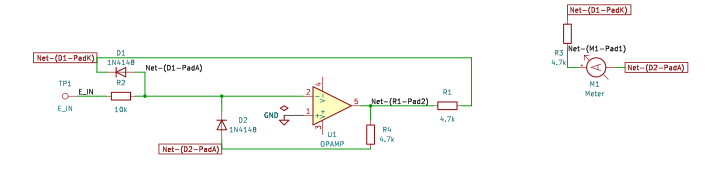
The schematic is drawn by copperhead’s
drafting engine from this circuit’s netlist, with KiCad’s own library symbols,
and it opens in KiCad as figure/simple_meter_amplifier.kicad_sch.
The op amp is KiCad’s generic one, since the handbook’s are ideal, and each
terminal is a test point named as the program names it. KiCad reads back from
the sheet exactly the connections the circuit has; draw_figures.py refuses to write
one that does not.
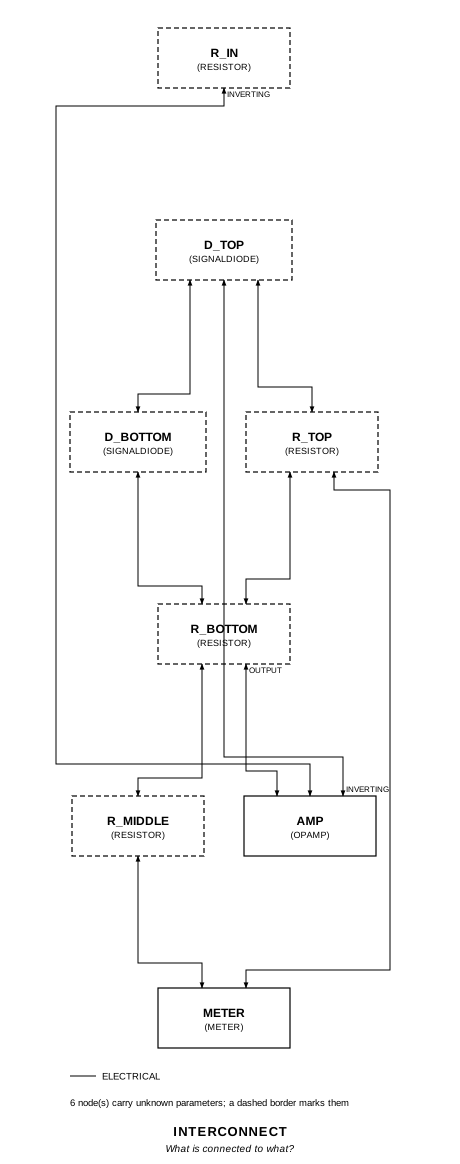
The interconnect view is fang’s own projection. It names the parts as the program does, so it reads against the code below.
What the program says
Section titled “What the program says”Whichever way the input current flows, one diode carries it and the meter takes the share that goes round through the middle branch, always in the same direction. That share is R_O / (3 R_O + R_M), which is the handbook’s third only when the meter’s own resistance R_M is small. Two things are recorded as decisions:
diodes: the diode symbols are too small to read. The program takes the upper diode pointing into the summing point and the lower one out of it; the other workable reading only reverses the meter.movement: the meter is 100 Ω, which keeps its share within 1% of a third.
g_meter is the meter’s average current per volt of rectified input for the
drawn circuit, and g_handbook is the page’s 1 / (3 R_I); a constraint holds
the two within 1% of each other.
What the simulation found
Section titled “What the simulation found”out/simulation.txt, a 100 Hz sine of 1 V peak, four
periods averaged:
| Measured | Value | Claimed |
|---|---|---|
| meter average / average of |E_I| | 33.10 µA/V | 33.10 µA/V (g_meter), holds |
| the same, against the handbook | 33.10 µA/V | 33.33 µA/V (g_handbook) ±1%, holds |
| meter average current | 21.07 µA | not a claim |
The meter reads the full-wave average of the input: 2/π of 1 V peak over 30.2 kΩ.
Running it
Section titled “Running it”fang check examples/ti_opamp_handbook/current_output/simple_meter_amplifier/simple_meter_amplifier.pypython examples/regenerate.py ti_opamp_handbook/current_output/simple_meter_amplifier # needs ngspiceThe whole program
Section titled “The whole program”"""The simple meter amplifier, SBOA092B page 79.Show 17 more lines
I_meter = E_I / (3 R_I) = E_I / 30 mA
E_I drives R_I into the summing point, and the feedback path from the outputback to it is a bridge: two diodes on the summing-point side, a 4.7 kOhm R_Oon each of the other two sides, and the meter in series with a third R_Oacross the middle. Whichever way the input current flows, one diode carriesit, and the meter takes the share that goes round through the middle branch,always in the same direction. That share is R_O / (3 R_O + R_M), a third whenthe meter's own resistance is small, so the meter is a full-wave rectifier'sreading of the input.
The figure draws the diodes too small to read which way they point, and themeter with no resistance, so `diodes` and `movement` record what was taken.The bench drives a 100 Hz sine of 1 V peak and reads the meter's averagecurrent against the average of |E_I|."""
import sysfrom pathlib import Path
# The handbook's shared parts and bench live in the folder above the sections.sys.path.insert(0, str(Path(__file__).resolve().parents[2]))
from decimal import Decimal
from fang.lang import Ohm, Parameter, System, UnitLiteral, kOhm, requirefrom fang.parts import Resistorfrom fang.rationale import Chooses, Citesfrom fang.simulation import Transient
from handbook import ( Bench, Claim, Ground, Meter, OpAmp, Run, SignalDiode, Terminal, over, product, ratio, total, within,)
#: A transconductance: the meter current per volt in.uA_per_V = UnitLiteral("uA/V")
class SimpleMeterAmplifier(System): """E_I through R_I, and a diode bridge with the meter in it as the feedback."""
figure = Cites( "I_meter = E_I / (3 R_I) = E_I / 30 mA. Linear current meter reads AC " "input voltage.", document="SBOA092B, Handbook of Operational Amplifier Applications", locator="page 79, Simple Meter Amplifier", )
diodes = Chooses( "Which way do the two diodes point?", selected=( "the upper one from the top corner into the summing point, the " "lower one from the summing point into the bottom corner" ), alternatives=[ { "reading": "both pointing away from the summing point, or both toward it", "reason": "then one polarity of input current has no path back to " "the output and the loop opens for half of every cycle", }, { "reading": "the mirror image: upper away from the summing point, lower into it", "reason": "that works too and reverses the meter current; the " "reading taken makes it flow bottom to top, the way the meter's " "arrow points", }, ], rationale=( "the diode symbols are too small in the figure to read their " "direction, so the only readings are the ones that close the loop " "for both polarities", ), )
movement = Chooses( "What is the meter's resistance?", selected="100 Ohm", alternatives=[ { "option": "a zero-ohm meter", "reason": "no movement has none, and the formula's third is the " "limit a real one approaches", }, { "option": "a 2 kOhm, 50 uA movement", "reason": "the meter takes R_O / (3 R_O + R_M) of the current, " "which at 2 kOhm is 0.29 rather than a third, 12% low", }, ], rationale=( "the meter's share is R_O / (3 R_O + R_M); 100 Ohm against 14.1 kOhm " "keeps it within 1% of the handbook's third", ), )
g_meter = Parameter( "uA/V", default=Decimal("33.098") * uA_per_V, description="average meter current over average |E_I|: R_O / ((3 R_O + R_M) R_I)", ) g_handbook = Parameter( "uA/V", default=Decimal("33.333") * uA_per_V, description="the handbook's 1 / (3 R_I)", )
e_in = Terminal() r_in = Resistor(resistance=10 * kOhm) amp = OpAmp() ground = Ground()
d_top = SignalDiode() d_bottom = SignalDiode() r_top = Resistor(resistance=4.7 * kOhm) r_bottom = Resistor(resistance=4.7 * kOhm) r_middle = Resistor(resistance=4.7 * kOhm) meter = Meter(resistance=100 * Ohm)
def architecture(self): self.e_in.probe >> self.r_in.p1 self.amp.non_inverting.signal >> self.ground.node
# The summing point is the bridge's left corner. self.r_in.p2 >> self.amp.inverting.signal self.amp.inverting.signal >> self.d_top.p2 self.d_top.p2 >> self.d_bottom.p1
# The top corner: the upper diode, the upper R_O, and the meter. self.d_top.p1 >> self.r_top.p1 self.r_top.p1 >> self.meter.p2
# The bottom corner: the lower diode, the lower R_O, and the middle R_O. self.d_bottom.p2 >> self.r_bottom.p1 self.r_bottom.p1 >> self.r_middle.p1 self.r_middle.p2 >> self.meter.p1
# The right corner is the output. self.r_top.p2 >> self.r_bottom.p2 self.r_bottom.p2 >> self.amp.output.signal
def constraints(self): r_o = self.r_top.resistance require( within( self.g_meter, over( r_o, product( total(r_o, self.r_bottom.resistance, self.r_middle.resistance, self.meter.resistance), self.r_in.resistance, ), ), 0.0001, ) ) require( within(self.g_handbook, over(1 * ratio, product(3 * ratio, self.r_in.resistance)), 0.0001) ) # The meter's resistance is small enough that the handbook's third holds. require(within(self.g_meter, self.g_handbook, 0.01))
BENCH = Bench( page=79, title="Simple Meter Amplifier", runs=[ Run( "sine", Transient(stop="60m", step="10u"), drive={"e_in": "SIN(0 1 100)"}, measure={ "i_avg": "avg i(vm1_sense) from=20m to=60m", "e_peak": "max v({e_in.1}) from=20m to=60m", "g_meter": "i_avg / (e_peak * 0.6366197723675814)", "g_handbook": "i_avg / (e_peak * 0.6366197723675814)", }, claims=[ Claim("g_meter", "g_meter", within=0.005, unit="A/V"), Claim( "g_handbook", "g_handbook", within=0.01, unit="A/V", note="the handbook's E_I / 30 mA, which the 100 Ohm meter " "takes 0.7% less than", ), ], units={"i_avg": "A", "e_peak": "V"}, note="A 100 Hz sine of 1 V peak, four whole periods averaged. The " "average of |E_I| is 2/pi of its peak, so the ratio is the meter's " "average current over the input's rectified average. The 0.5% " "allowance covers the diode's turn-on at each zero crossing, which " "the loop closes over but not instantly.", ), ],)The files it writes
Section titled “The files it writes”The parts, then the nets and the pads on them.
D1 SignalDiode -D2 SignalDiode -GND1 Ground -M1 Meter -R1 4.7 kOhm -R2 10 kOhm -R3 4.7 kOhm -R4 4.7 kOhm -TP1 Terminal -U1 OpAmp -Net-(D1-PadA) D1.A D2.K R2.2 U1.IN-Net-(D1-PadK) D1.K R1.1 R3.1Net-(D2-PadA) D2.A M1.2 R4.1Net-(GND1-Pad1) GND1.1 U1.IN+Net-(M1-Pad1) M1.1 R3.2Net-(R1-Pad2) R1.2 R4.2 U1.OUTNet-(R2-Pad1) R2.1 TP1.1Every check that ran, and every one left undecided.
3 checks, 0 failed, 0 undecidedWhat the elaborated graph contains, by entity kind.
1 block 10 component 24 connection 3 constraint 2 decision 1 evidence 3 interface 19 pin 19 port 82 totalsnapshot sha256:15d6277cef85bcb7f90d135e2a9eb5b6a3b1583f84a84eb784d3a541cad5f1beAll of it, including the KiCad netlist, is in
examples/ti_opamp_handbook/current_output/simple_meter_amplifier/out/. Rebuild it with:
fang build examples/ti_opamp_handbook/current_output/simple_meter_amplifier/simple_meter_amplifier.py