
Examples / TI op amp handbook / Summers
Averager
SBOA092B page 65, Averager: E1, E2 and E3 each through 30 kΩ into the summing point, 10 kΩ from the output back to it.
E_O = -(R_O/R_I)(E1 + E2 + E3) = -(E1 + E2 + E3)/3R_O = R_I divided by number of inputsThe circuit
Section titled “The circuit”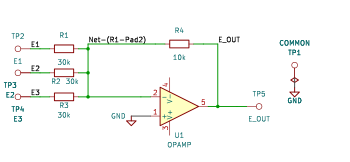
The schematic is drawn by copperhead’s
drafting engine from this circuit’s netlist, with KiCad’s own library symbols,
and it opens in KiCad as figure/averager.kicad_sch.
The op amp is KiCad’s generic one, since the handbook’s are ideal, and each
terminal is a test point named as the program names it. KiCad reads back from
the sheet exactly the connections the circuit has; draw_figures.py refuses to write
one that does not.
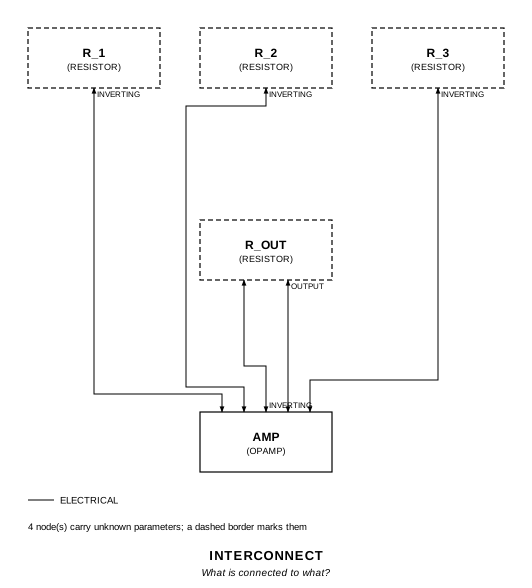
The interconnect view is fang’s own projection. It names the parts as the program does, so it reads against the code below.
What the program says
Section titled “What the program says”The page’s rule is the constraint, with the count of inputs as a parameter,
inputs = 3, written without the division so it is exact:
require(equals(product(self.inputs, self.r_out.resistance), r_i.resistance))The bench measures that count back as the divisor, -(E1 + E2 + E3)/E_O. The figure gives every value, so nothing was chosen.
What the simulation found
Section titled “What the simulation found”out/simulation.txt, from the decks under
out/spice/:
| Run | Measured | Claimed |
|---|---|---|
average, E1..E3 = 1, 2, 4.5 V: E_O | -2.5 V | -2.5 V, holds |
average: the divisor | 3 | 3 (inputs), holds |
unused_input_grounded, E3 = 0 V: E_O | -1 V | -1 V, holds |
unused_input_open, E3 left open: E_O | -1 V | -1 V, holds |
The page’s next line says to ground unused inputs to preserve scale. In this inverting circuit an open input gives the same E_O as a grounded one: the open resistor sits at the summing point’s ground and carries nothing, so the unused input counts as zero either way and the divisor stays 3. What grounding does change is the noise gain (2 with all three resistors to ground, 1.67 with one open), which sets the output offset and bandwidth, not the scale.
Running it
Section titled “Running it”fang check examples/ti_opamp_handbook/summers/averager/averager.pypython examples/regenerate.py ti_opamp_handbook/summers/averager # needs ngspiceThe whole program
Section titled “The whole program”"""The averager, SBOA092B page 65.Show 19 more lines
E_O = -(R_O/R_I)(E1 + E2 + E3) = -(E1 + E2 + E3)/3
The adder with each input resistor made three times R_O: three 30 kOhm R_Iinto the summing point, 10 kOhm back. Each input is weighted -1/3, so theoutput is the inverted average. The page's rule is R_O = R_I divided by thenumber of inputs, and the program holds the parts to it with the count as aparameter, which is also the divisor the bench measures.
The next page adds: ground unused inputs to preserve scale. The bench triesboth. In this inverting circuit a grounded input and an open one give the sameE_O, because the summing point is at ground either way and an open R_I carriesno current just as a grounded one does: the unused input counts as a zero inthe average and the divisor stays 3. What grounding changes is the noisegain, 1 + R_O/(R_I/3) = 2 against 1 + R_O/(R_I/2) = 1.67, which moves theoutput offset and bandwidth, not the scale.
The figure gives every value, so nothing was chosen."""
import sysfrom pathlib import Path
# The handbook's shared parts and bench live in the folder above the sections.sys.path.insert(0, str(Path(__file__).resolve().parents[2]))
from fang.lang import Parameter, System, kOhm, requirefrom fang.parts import Resistorfrom fang.rationale import Citesfrom fang.simulation import OperatingPoint
from handbook import ( Bench, Claim, Ground, OpAmp, Run, Terminal, equals, product, ratio,)
class Averager(System): """E1, E2, E3 each through 30 kOhm into the summing point, 10 kOhm back."""
figure = Cites( "E_O = -R_O/R_I (E1 + E2 + E3) = -(E1 + E2 + E3)/3. R_O = R_I divided by " "number of inputs. Output is inverted average of input signals. Ground " "unused inputs to preserve scale", document="SBOA092B, Handbook of Operational Amplifier Applications", locator="pages 65 and 66, Averager", )
inputs = Parameter("1", default=3 * ratio, description="how many inputs are averaged")
e1 = Terminal() e2 = Terminal() e3 = Terminal() common = Terminal() e_out = Terminal()
r_1 = Resistor(resistance=30 * kOhm) r_2 = Resistor(resistance=30 * kOhm) r_3 = Resistor(resistance=30 * kOhm) r_out = Resistor(resistance=10 * kOhm) amp = OpAmp() ground = Ground()
def architecture(self): self.e1.probe >> self.r_1.p1 self.e2.probe >> self.r_2.p1 self.e3.probe >> self.r_3.p1 self.r_1.p2 >> self.amp.inverting.signal self.r_2.p2 >> self.amp.inverting.signal self.r_3.p2 >> self.amp.inverting.signal self.amp.inverting.signal >> self.r_out.p1 self.r_out.p2 >> self.amp.output.signal self.amp.output.signal >> self.e_out.probe self.amp.non_inverting.signal >> self.ground.node self.common.probe >> self.ground.node
def constraints(self): # R_O = R_I / n, written without the division so it is exact: n R_O = R_I. for r_i in (self.r_1, self.r_2, self.r_3): require(equals(product(self.inputs, self.r_out.resistance), r_i.resistance))
BENCH = Bench( page=65, title="Averager", runs=[ Run( "average", OperatingPoint(), drive={"e1": "DC 1", "e2": "DC 2", "e3": "DC 4.5"}, measure={ "e_o": "v({e_out.1})", "divisor": "-(v({e1.1}) + v({e2.1}) + v({e3.1})) / v({e_out.1})", }, claims=[ Claim("e_o", -2.5, within=0.001, unit="V", note="-(1 + 2 + 4.5)/3 = -2.5 V"), Claim("divisor", "inputs", within=0.001, note="-(E1 + E2 + E3)/E_O: the number of inputs"), ], ), Run( "unused_input_grounded", OperatingPoint(), drive={"e1": "DC 1", "e2": "DC 2", "e3": "DC 0"}, measure={"e_o": "v({e_out.1})"}, claims=[ Claim("e_o", -1.0, within=0.001, unit="V", note=( "E3 grounded: -(1 + 2 + 0)/3 = -1 V. The scale is kept, " "and the grounded input counts as a zero in the average." )), ], ), Run( "unused_input_open", OperatingPoint(), drive={"e1": "DC 1", "e2": "DC 2"}, measure={"e_o": "v({e_out.1})", "e3_open": "v({e3.1})"}, claims=[ Claim("e_o", -1.0, within=0.001, unit="V", note=( "E3 left open gives the same -1 V: the open R_I sits at the " "summing point's ground and carries nothing. The page's " "advice does not change the scale of this circuit." )), ], units={"e3_open": "V"}, ), ],)The files it writes
Section titled “The files it writes”The parts, then the nets and the pads on them.
GND1 Ground -R1 30 kOhm -R2 30 kOhm -R3 30 kOhm -R4 10 kOhm -TP1 Terminal -TP2 Terminal -TP3 Terminal -TP4 Terminal -TP5 Terminal -U1 OpAmp -Net-(GND1-Pad1) GND1.1 TP1.1 U1.IN+Net-(R1-Pad1) R1.1 TP2.1Net-(R1-Pad2) R1.2 R2.2 R3.2 R4.1 U1.IN-Net-(R2-Pad1) R2.1 TP3.1Net-(R3-Pad1) R3.1 TP4.1Net-(R4-Pad2) R4.2 TP5.1 U1.OUTEvery check that ran, and every one left undecided.
3 checks, 0 failed, 0 undecidedWhat the elaborated graph contains, by entity kind.
1 block 11 component 22 connection 3 constraint 1 evidence 3 interface 17 pin 17 port 75 totalsnapshot sha256:0f8827f07b5a05680dba014eb88ec90912d0f16e105cb8dea83a92944bd8653eAll of it, including the KiCad netlist, is in
examples/ti_opamp_handbook/summers/averager/out/. Rebuild it with:
fang build examples/ti_opamp_handbook/summers/averager/averager.py