
Examples / TI op amp handbook / Lead and lag
Adjustable lag
SBOA092B page 84, Adjustable Lag: a 10 kΩ pot from EI to the summing point with its wiper through C = 10 µF to ground, and RO = 10 kΩ across.
E_O = -E_I / (1 + (D - D²) R C P) = -40 E_I / (40 + P)The circuit
Section titled “The circuit”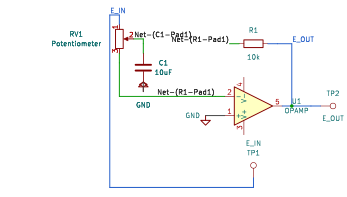
The schematic is drawn by copperhead’s
drafting engine from this circuit’s netlist, with KiCad’s own library symbols,
and it opens in KiCad as figure/adjustable_lag.kicad_sch.
The op amp is KiCad’s generic one, since the handbook’s are ideal, and each
terminal is a test point named as the program names it. KiCad reads back from
the sheet exactly the connections the circuit has; draw_figures.py refuses to write
one that does not.
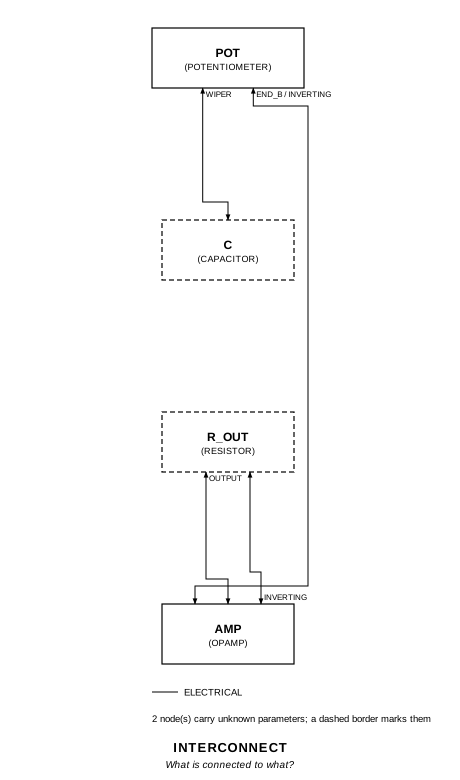
The interconnect view is fang’s own projection. It names the parts as the program does, so it reads against the code below.
What the program says
Section titled “What the program says”At DC the capacitor is open and the whole pot is in series with E_I, so the
gain is a_v = -R_O / R = -1 at any setting. The capacitor sees
(D - D²) R, which is largest at D = 1/2: R C / 4 = 25 ms, the page’s
-40/(40 + P). The program holds its claims at D = 1/2 (setting) and adds a
second setting, d_other = 0.1, with its corner f_other. The printed formula
checks out.
What the simulation found
Section titled “What the simulation found”| Run | Measured | Claimed |
|---|---|---|
dc_gain, D = 1/2 | -1 | -1 (a_v), holds |
dc_gain_other, D = 0.1 | -1 | -1 (a_v), holds |
lag_centered, -3 dB point | 6.366 Hz | 6.366 Hz (f_c), holds |
lag_centered, phase at the corner | 2.356 rad (135°) | 135°, holds |
lag_other, -3 dB point | 17.68 Hz | 17.68 Hz (f_other), holds |
lag_other, phase at the corner | 2.356 rad (135°) | 135°, holds |
The wiper moves the corner and leaves the DC gain alone, as the page says.
Running it
Section titled “Running it”fang check examples/ti_opamp_handbook/lead_lag/adjustable_lag/adjustable_lag.pypython examples/regenerate.py ti_opamp_handbook/lead_lag/adjustable_lag # needs ngspiceThe whole program
Section titled “The whole program”"""The adjustable lag, SBOA092B page 84.Show 15 more lines
E_O = -E_I / (1 + (D - D^2) R C P) = -40 E_I / (40 + P)
A 10 kOhm potentiometer runs from E_I to the summing point, and its wipergoes through C = 10 uF to ground; R_O = 10 kOhm closes the loop. At DC thecapacitor is open, the pot is a plain 10 kOhm in series, and the gain is-R_O/R = -1 whatever the setting. At frequency the wiper is shunted to ground,and solving the wiper node gives one pole with time constant (D - D^2) R C,where D is the setting counted from either end (the product is symmetric).It is largest at D = 1/2, R C / 4 = 25 ms, the -40/(40 + P) the page prints.
The figure leaves the setting to the reader. `setting` records that theclaims are held at the page's own D = 1/2, and the bench moves the wiper toD = 0.1 to show the corner move while the DC gain stays put."""
import sysfrom decimal import Decimalfrom pathlib import Path
# The handbook's shared parts and bench live in the folder above the sections.sys.path.insert(0, str(Path(__file__).resolve().parents[2]))
from fang.lang import Hz, Parameter, System, kOhm, require, uFfrom fang.parts import Capacitor, Resistorfrom fang.rationale import Chooses, Citesfrom fang.simulation import ACSweep, OperatingPoint
from handbook import ( Bench, Claim, Ground, OpAmp, Potentiometer, Run, Terminal, corner, equals, minus, negative, over, product, ratio, within,)
def lag(setting, resistance): """(D - D^2) R: the resistance the capacitor sees, as it sets the pole.""" return product(minus(setting, product(setting, setting)), resistance)
class AdjustableLag(System): """E_I through the pot into the summing point, the wiper to ground through C, R_O across."""
figure = Cites( "E_O = -E_I / (1 + (D - D^2) R C P) = -40 E_I / (40 + P); non-integrating " "type, constant inverting unity gain, maximum lag for R centered for D = 1/2", document="SBOA092B, Handbook of Operational Amplifier Applications", locator="page 84, Adjustable Lag", )
setting = Chooses( "Where is the wiper when the claims are held?", selected="D = 1/2, the page's own setting, where the lag is largest: 40 rad/s, 6.37 Hz", alternatives=[ { "option": "D = 0.1", "reason": "checked on the bench as a second point; the page prints its numbers at D = 1/2", }, { "option": "D at either end", "reason": "D - D^2 is 0 there and the lag vanishes: the circuit is a plain inverter", }, ], rationale=( "the page prints -40/(40 + P), which is R C / 4 = 25 ms", "D - D^2 is symmetric, so which end D counts from does not matter", ), )
a_v = Parameter("1", default=-1 * ratio, description="E_O / E_I at DC, any setting") f_c = Parameter("Hz", default=6.3662 * Hz, description="the corner at D = 1/2") d_other = Parameter("1", default=Decimal("0.1") * ratio, description="the second setting the bench checks") f_other = Parameter("Hz", default=17.684 * Hz, description="the corner at D = 0.1")
e_in = Terminal() e_out = Terminal() pot = Potentiometer(resistance=10 * kOhm, setting=Decimal("0.5") * ratio) c = Capacitor(capacitance=10 * uF) r_out = Resistor(resistance=10 * kOhm) amp = OpAmp() ground = Ground()
def architecture(self): self.e_in.probe >> self.pot.end_a self.pot.end_b >> self.amp.inverting.signal self.pot.wiper >> self.c.p1 self.c.p2 >> self.ground.node self.amp.inverting.signal >> self.r_out.p1 self.r_out.p2 >> self.amp.output.signal self.amp.output.signal >> self.e_out.probe self.amp.non_inverting.signal >> self.ground.node
def constraints(self): # At DC C is open: the whole pot is in series with E_I. require(equals(self.a_v, negative(over(self.r_out.resistance, self.pot.resistance)))) # The pole, at the drawn setting and at the second one. require(within(self.f_c, corner(lag(self.pot.setting, self.pot.resistance), self.c.capacitance), 0.0001)) require(within(self.f_other, corner(lag(self.d_other, self.pot.resistance), self.c.capacitance), 0.0001))
def _sweep(name, setting, corner_claim, corner_hz, note): return Run( name, ACSweep(points=200, start="100m", stop="1k"), drive={"e_in": "DC 0 AC 1"}, settings={"pot": {"setting": setting}}, measure={ "gain_low": "find vm({e_out.1}) at=100m", "f_3db": "when vdb({e_out.1})=-3.0103 fall=1", "phase_c": f"find vp({{e_out.1}}) at={corner_hz}", }, claims=[ Claim("gain_low", 1, within=0.001, note="unity, the DC gain's magnitude, well below the corner"), Claim("f_3db", corner_claim, within=0.005, unit="Hz"), Claim( "phase_c", 2.35619, within=0.005, note="radians: 135 degrees at the corner, the inversion's 180 less the pole's 45", ), ], units={"f_3db": "Hz"}, note=note, )
BENCH = Bench( page=84, title="Adjustable Lag", runs=[ Run( "dc_gain", OperatingPoint(), drive={"e_in": "DC 1"}, measure={"gain": "v({e_out.1}) / v({e_in.1})"}, claims=[Claim("gain", "a_v", within=0.001)], ), Run( "dc_gain_other", OperatingPoint(), drive={"e_in": "DC 1"}, settings={"pot": {"setting": 0.1}}, measure={"gain": "v({e_out.1}) / v({e_in.1})"}, claims=[Claim("gain", "a_v", within=0.001, note="the wiper moved, and the DC gain did not")], ), _sweep( "lag_centered", 0.5, "f_c", 6.3662, "D = 1/2: the page's -40/(40 + P), a corner at 40 rad/s.", ), _sweep( "lag_other", 0.1, "f_other", 17.684, "D = 0.1: (D - D^2) R C = 9 ms, a corner at 111 rad/s. Less lag than at the center.", ), ],)The files it writes
Section titled “The files it writes”The parts, then the nets and the pads on them.
C1 10 uF -GND1 Ground -R1 10 kOhm -RV1 Potentiometer -TP1 Terminal -TP2 Terminal -U1 OpAmp -Net-(C1-Pad1) C1.1 RV1.2Net-(C1-Pad2) C1.2 GND1.1 U1.IN+Net-(R1-Pad1) R1.1 RV1.3 U1.IN-Net-(R1-Pad2) R1.2 TP2.1 U1.OUTNet-(RV1-Pad1) RV1.1 TP1.1Every check that ran, and every one left undecided.
3 checks, 0 failed, 0 undecidedWhat the elaborated graph contains, by entity kind.
1 block 7 component 16 connection 3 constraint 1 decision 1 evidence 3 interface 13 pin 13 port 58 totalsnapshot sha256:993f2b406555bbe5e71c9dfd024a6d98127ed7eff37978691a14c38c5ecc128dAll of it, including the KiCad netlist, is in
examples/ti_opamp_handbook/lead_lag/adjustable_lag/out/. Rebuild it with:
fang build examples/ti_opamp_handbook/lead_lag/adjustable_lag/adjustable_lag.py