
Examples / TI op amp handbook / AC amplifiers
Single supply
SBOA092B page 76, Single Supply: the simple a.c. amplifier above it, with the + input held at half the supply by R2 10 kΩ and R2' 10 kΩ and bypassed by C2 100 µF. "Equivalent to above, with the supply 'floated' above ground."
The circuit
Section titled “The circuit”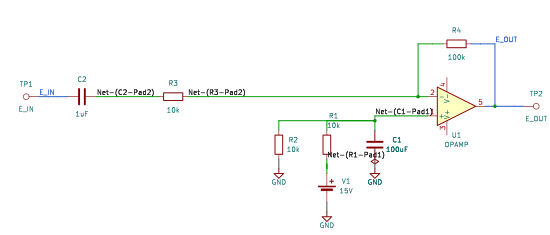
The schematic is drawn by copperhead’s
drafting engine from this circuit’s netlist, with KiCad’s own library symbols,
and it opens in KiCad as figure/single_supply.kicad_sch.
The op amp is KiCad’s generic one, since the handbook’s are ideal, and each
terminal is a test point named as the program names it. KiCad reads back from
the sheet exactly the connections the circuit has; draw_figures.py refuses to write
one that does not.
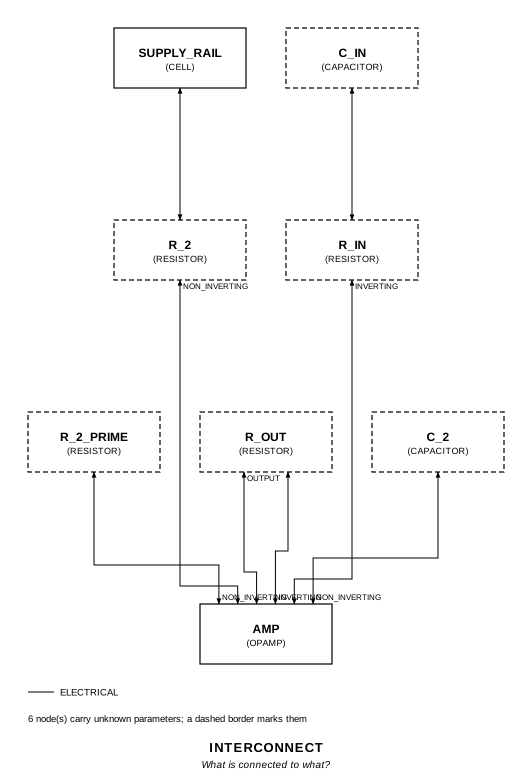
The interconnect view is fang’s own projection. It names the parts as the program does, so it reads against the code below.
What the program says
Section titled “What the program says”The page gives no supply voltage, so supply chooses 15 V and an op amp
that swings from 0 V to 13.5 V on it. The supply is a Cell in the graph;
the op amp has no supply pins in this harness, so the rail feeds only the
divider and the swing is set on the model. The claims are the ones
“equivalent to above” implies: gain -10 (a_v), a 16 Hz corner (f_low,
within 1% of 1/(2 pi R_I C_I)), and a d.c. output of half the supply
(e_bias, held to the divider by a constraint).
What the simulation found
Section titled “What the simulation found”| Run | Measured | Claimed |
|---|---|---|
bias, E_O with no signal | 7.5 V | 7.5 V (e_bias), holds |
response, gain at 1 kHz | 9.999 | 10, holds |
response, low -3 dB point | 15.92 Hz | 16 Hz (f_low) ±1%, holds |
signal, 0.5 V 1 kHz sine: highest E_O | 12.5 V | 12.5 V, holds |
signal, lowest E_O | 2.501 V | 2.5 V, holds |
signal, mean E_O | 7.5 V | 7.5 V (e_bias), holds |
The transient is read over the last 5 ms of 80, after the 10 ms C_I R_I transient of switching the sine on has settled; read earlier, the mean sits about 56 mV high.
Running it
Section titled “Running it”fang check examples/ti_opamp_handbook/ac_amplifiers/single_supply/single_supply.pypython examples/regenerate.py ti_opamp_handbook/ac_amplifiers/single_supply # needs ngspiceThe whole program
Section titled “The whole program”"""The single-supply a.c. amplifier, SBOA092B page 76.Show 15 more lines
"Equivalent to above, with the supply 'floated' above ground."
The simple a.c. amplifier on the same page, run from one supply. R_2 and R_2'split the supply in half onto the + input, and C_2 holds that node still.C_I blocks the half-supply from the source, and at d.c. the stage is afollower of its + input, so the output rests at half the supply. Above theC_I R_I corner the signal sees the inverting amplifier of page 54 again,-R_O / R_I = -10, riding on that level.
The page gives no formula and no supply voltage, so the claims are the ones"equivalent to above" implies: a gain of -10, the 16 Hz corner, and a d.c.output of half the supply. The program chose the supply and what the op ampcan swing on it (`supply`)."""
import sysfrom pathlib import Path
# The handbook's shared parts and bench live in the folder above the sections.sys.path.insert(0, str(Path(__file__).resolve().parents[2]))
from fang.lang import Hz, Parameter, System, V, kOhm, require, uFfrom fang.parts import Capacitor, Resistorfrom fang.rationale import Chooses, Citesfrom fang.simulation import ACSweep, OperatingPoint, Transient
from handbook import ( Bench, Cell, Claim, Ground, OpAmp, Run, Terminal, corner, equals, negative, over, product, ratio, total, within,)
class SingleSupply(System): """The simple a.c. amplifier with its + input biased at half of one supply."""
figure = Cites( "Equivalent to above, with the supply \"floated\" above ground. " "(Above: E_O = -10 E_I, f_-3dB = 1 / (2 pi R_I C_I) = 16 Hz.)", document="SBOA092B, Handbook of Operational Amplifier Applications", locator="page 76, Single Supply", )
supply = Chooses( "What is +Supply, and what can the op amp swing on it?", selected=( "15 V, and an output from 0 V to 13.5 V: to ground at the bottom, " "and 1.5 V short of the rail at the top, like the bench's op amp on " "+/-15 V" ), alternatives=[ { "option": "the bench's default +/-13.5 V swing", "reason": "a single-supply part cannot go below its only other rail, ground", }, { "option": "a rail-to-rail 0 to 15 V swing", "reason": "the handbook's op amps are not rail-to-rail; the headroom is the conservative reading", }, ], rationale=( "the figure labels the rail +Supply and gives no value", "15 V is the rail the handbook's other circuits run from", ), )
a_v = Parameter("1", default=-10 * ratio, description="E_O / E_I in the midband") f_low = Parameter("Hz", default=16 * Hz, description="the low-frequency -3 dB point") e_bias = Parameter("V", default=7.5 * V, description="the d.c. level at the output")
e_in = Terminal() e_out = Terminal() supply_rail = Cell(voltage=15 * V) c_in = Capacitor(capacitance=1 * uF) r_in = Resistor(resistance=10 * kOhm) r_out = Resistor(resistance=100 * kOhm) r_2 = Resistor(resistance=10 * kOhm) r_2_prime = Resistor(resistance=10 * kOhm) c_2 = Capacitor(capacitance=100 * uF) amp = OpAmp(output_high=13.5 * V, output_low=0 * V) ground = Ground()
def architecture(self): self.e_in.probe >> self.c_in.p1 self.c_in.p2 >> self.r_in.p1 self.r_in.p2 >> self.amp.inverting.signal self.amp.inverting.signal >> self.r_out.p1 self.r_out.p2 >> self.amp.output.signal self.amp.output.signal >> self.e_out.probe
# Half the supply onto the + input, held there by C_2. self.supply_rail.p1 >> self.r_2.p1 self.r_2.p2 >> self.amp.non_inverting.signal self.amp.non_inverting.signal >> self.r_2_prime.p1 self.amp.non_inverting.signal >> self.c_2.p1
self.supply_rail.p2 >> self.ground.node self.r_2_prime.p2 >> self.ground.node self.c_2.p2 >> self.ground.node
def constraints(self): require(equals(self.a_v, negative(over(self.r_out.resistance, self.r_in.resistance)))) require(within(self.f_low, corner(self.r_in.resistance, self.c_in.capacitance), 0.01)) # C_I blocks d.c., so the output follows the + input: the divider's tap. require( equals( self.e_bias, product( self.supply_rail.voltage, over(self.r_2_prime.resistance, total(self.r_2.resistance, self.r_2_prime.resistance)), ), ) )
BENCH = Bench( page=76, title="Single Supply", runs=[ Run( "bias", OperatingPoint(), drive={"e_in": "DC 0"}, measure={"e_out": "v({e_out.1})", "e_plus": "v({amp.IN+})"}, claims=[Claim("e_out", "e_bias", within=0.001, unit="V")], units={"e_plus": "V"}, ), Run( "response", ACSweep(points=40, start="0.1", stop="10meg"), drive={"e_in": "DC 0 AC 1"}, measure={ "gain_1k": "find vm({e_out.1}) at=1k", "f_3db": "when vdb({e_out.1})=16.9897 cross=1", }, claims=[ Claim("gain_1k", 10, within=0.001, note="the magnitude of -10"), Claim( "f_3db", "f_low", within=0.01, unit="Hz", note="1/(2 pi R_I C_I) is 15.92 Hz, as above; the handbook prints 16", ), ], units={"f_3db": "Hz"}, ), Run( "signal", Transient(stop="80m", step="2u"), drive={"e_in": "SIN(0 0.5 1k)"}, measure={ "e_top": "max v({e_out.1}) from=75m to=80m", "e_bottom": "min v({e_out.1}) from=75m to=80m", "e_mean": "avg v({e_out.1}) from=75m to=80m", }, claims=[ Claim("e_top", 12.5, within=0.005, unit="V", note="7.5 V + 10 x 0.5 V"), Claim("e_bottom", 2.5, within=0.005, unit="V", note="7.5 V - 10 x 0.5 V"), Claim("e_mean", "e_bias", within=0.005, unit="V"), ], note=( "A 0.5 V, 1 kHz sine: the output swings 5 V either side of its " "7.5 V rest, inside the 0 V to 13.5 V it can reach. It is read " "over the last 5 ms of 80, after the 10 ms C_I R_I transient " "of switching the sine on has died away. The tolerance is " "0.5% for the sampled peaks." ), ), ],)The files it writes
Section titled “The files it writes”The parts, then the nets and the pads on them.
C1 100 uF -C2 1 uF -GND1 Ground -R1 10 kOhm -R2 10 kOhm -R3 10 kOhm -R4 100 kOhm -TP1 Terminal -TP2 Terminal -U1 OpAmp -V1 15 V -Net-(C1-Pad1) C1.1 R1.2 R2.1 U1.IN+Net-(C1-Pad2) C1.2 GND1.1 R2.2 V1.-Net-(C2-Pad1) C2.1 TP1.1Net-(C2-Pad2) C2.2 R3.1Net-(R1-Pad1) R1.1 V1.+Net-(R3-Pad2) R3.2 R4.1 U1.IN-Net-(R4-Pad2) R4.2 TP2.1 U1.OUTEvery check that ran, and every one left undecided.
3 checks, 0 failed, 0 undecidedWhat the elaborated graph contains, by entity kind.
1 block 11 component 26 connection 3 constraint 1 decision 1 evidence 3 interface 20 pin 20 port 86 totalsnapshot sha256:302584e608538e755a2c9aab860b8b7b5ab684658c137b02b4d24137ab1875ecAll of it, including the KiCad netlist, is in
examples/ti_opamp_handbook/ac_amplifiers/single_supply/out/. Rebuild it with:
fang build examples/ti_opamp_handbook/ac_amplifiers/single_supply/single_supply.py