
Examples / TI op amp handbook / Additional circuits
Time delay relay
SBOA092B page 90, Time Delay: a reset integrator that ramps down from half the supply and, when it runs out, drops its output onto a clamp and pulls in a 6 V, 1 kΩ relay.
Delay = R_I C_O / (2 K), K the setting of R_7, 0 < K < 1The circuit
Section titled “The circuit”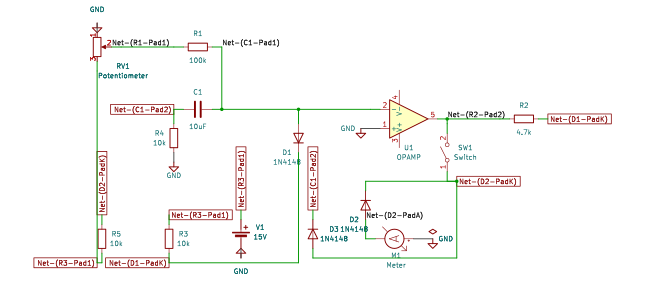
The schematic is drawn by copperhead’s
drafting engine from this circuit’s netlist, with KiCad’s own library symbols,
and it opens in KiCad as figure/time_delay_relay.kicad_sch.
The op amp is KiCad’s generic one, since the handbook’s are ideal, and each
terminal is a test point named as the program names it. KiCad reads back from
the sheet exactly the connections the circuit has; draw_figures.py refuses to write
one that does not.
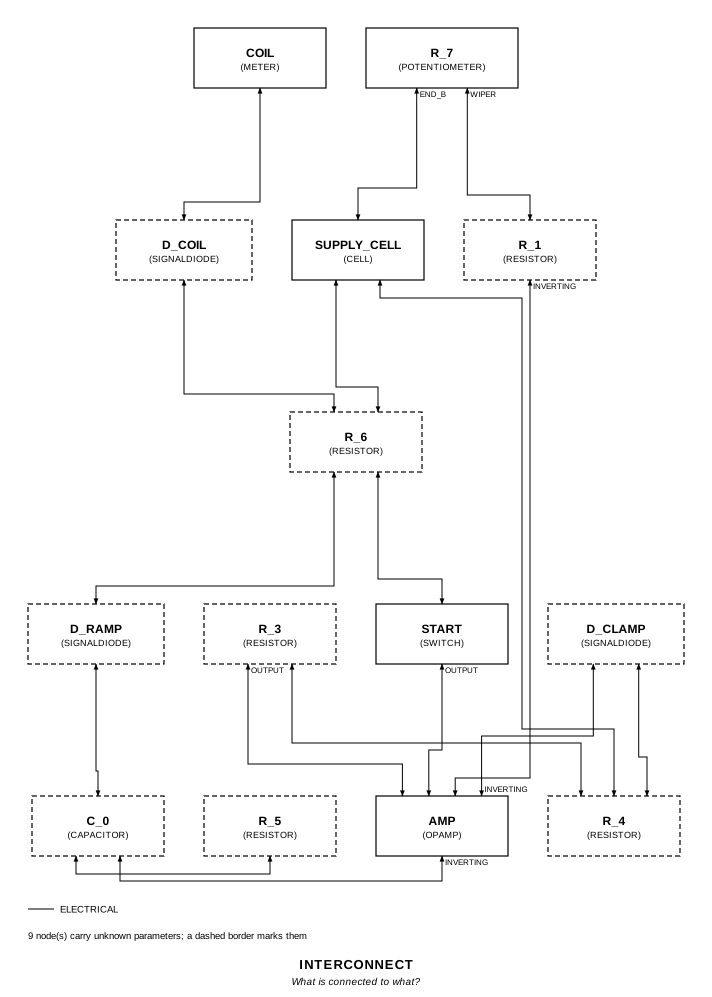
The interconnect view is fang’s own projection. It names the parts as the program does, so it reads against the code below.
What the program says
Section titled “What the program says”This is the least clean figure in the handbook, and the reading is recorded in
full (reading), with the three readings it rejected. As read:
- R_7 across the supply; its wiper through R_1 (100 kΩ) into the - input.
- C_0 (10 µF) from the - input to a node T, which R_5 (10 kΩ) returns to ground. C_0 does not go to the output: both crossings on the page are hops.
- A node S, pulled up by R_6 (10 kΩ), feeds T through a diode, and the switch connects S to the op amp output.
- R_4 and R_3 from the supply to the output, with a diode from the - input into their junction: a clamp about 7.9 V below ground.
- The coil from ground through a diode into S.
Reset (switch open): R_6 and R_5 hold T at 7.2 V and the output sits on its clamp. Close the switch and the output rises to a diode above T, C_0 becomes the integrator’s capacitor, and T ramps down at K E / (R_1 C_0). When the ramp can no longer feed R_5 the diode into T lets go, the output falls to its clamp, S follows it below ground, and about 7 mA flows up through the coil. E/2 at K E / (R_1 C_0) a second is the page’s R_1 C_0 / (2K).
The relay is a Meter of 1 kΩ, pulling in when its current passes 4.5 mA, 75%
of rated (relay). The supply is 15 V (supply). The page’s formula is the
parameter delay, held by
require(equals(self.delay, over(product(self.r_1.resistance, self.c_0.capacitance), product(2 * ratio, self.r_7.setting))))What the simulation found
Section titled “What the simulation found”out/simulation.txt, the switch closing at 0.1 s:
| Run | Measured | Claimed |
|---|---|---|
k_tenth, K = 0.1, delay to pull-in | 4.753 s | 5 s (delay) ± 7%, holds |
k_tenth, coil current during reset | -2.5 nA | 0 ± 10 µA, holds |
k_tenth, coil current as the switch closes | 18 µA | 0 ± 1 mA, holds |
k_tenth, coil current once pulled in | 7.0 mA | not a claim |
k_half, K = 0.5, delay to pull-in | 886 ms | 886 ms (the program’s estimate) ± 2%, holds |
k_half, coil current as the switch closes | 18 µA | 0 ± 1 mA, holds |
Where the handbook is off
Section titled “Where the handbook is off”The formula is the idealisation, and it runs long. T starts half a diode drop
below E/2, the ramp ends at R_5 K E / R_1 rather than at zero, and the wiper
adds R_7 K (1 - K) to R_1. Together (shortfall) they predict 4.75 s at
K = 0.1, 5% under the page’s 5 s, and 0.886 s at K = 0.5, 11% under 1 s. The
simulation lands on both. The page’s formula is claimed only at K = 0.1, where
it is closest, with a 7% tolerance that says why.
Running it
Section titled “Running it”fang check examples/ti_opamp_handbook/additional/time_delay_relay/time_delay_relay.pypython examples/regenerate.py ti_opamp_handbook/additional/time_delay_relay # needs ngspiceThe whole program
Section titled “The whole program”"""The time delay, SBOA092B page 90: a timer that pulls in a relay.Show 33 more lines
Delay = R_I C_O / (2 K), K the setting of R_7, 0 < K < 1
The least clean figure in the handbook, so the reading is recorded in full as adecision (`reading`). As read here:
- R_7 (10 kOhm) is across the supply, and its wiper feeds R_1 (100 kOhm, the R_I of the formula) into the op amp's - input. The + input is on ground.- C_0 (10 uF, the C_O) runs from the - input to a node T, not to the output. T goes to ground through R_5 (10 kOhm), and is reached from a node S by a diode pointing into T.- S is pulled up to the supply by R_6 (10 kOhm), and the switch connects S to the op amp output.- The output goes to the supply through R_3 (4.7 kOhm) and R_4 (10 kOhm) in series, and a diode from the - input points into their junction. That is a clamp: it catches the output about 8 V below ground.- The relay coil (1 kOhm, 6 V) goes from ground through a diode into S, so it conducts only when S is pulled below ground.
With the switch open (reset), R_6 and R_5 hold T at half the supply less adiode drop, the op amp sits on its clamp with its - input at ground, and C_0charges to about 7.2 V. Closing the switch hands S to the op amp: it rises toa diode above T and C_0 becomes an integrator's capacitor, and T ramps down atK E / (R_1 C_0) volts a second. When the ramp can no longer supply R_5, thediode into T lets go, the loop opens, the output falls to its clamp, S followsit below ground, and the coil pulls in. From half the supply at K E / (R_1C_0) is R_1 C_0 / (2 K): the page's formula.
It leaves out the diode drop at the start, the ramp stopping at R_5 K E / R_1rather than at zero, and the wiper's own resistance, which together make thedelay a few percent short. The program claims the page's formula at K = 0.1with that stated."""
import sysfrom decimal import Decimalfrom pathlib import Path
# The handbook's shared parts and bench live in the folder above the sections.sys.path.insert(0, str(Path(__file__).resolve().parents[2]))
from fang.lang import Ohm, Parameter, System, V, kOhm, require, s, uFfrom fang.parts import Capacitor, Resistorfrom fang.rationale import Calculates, Chooses, Citesfrom fang.simulation import Transient
from handbook import ( Bench, Cell, Claim, Ground, Meter, OpAmp, Potentiometer, Run, SignalDiode, Switch, equals, over, product, ratio,)
class TimeDelayRelay(System): """A reset integrator that ramps down from half the supply, and a relay at the end."""
figure = Cites( "Delay = R_I C_O / (2 K_I), where K is setting of R_I, 0 < K < 1. " "Time operated relay. Open switch to reset, close to begin timing.", document="SBOA092B, Handbook of Operational Amplifier Applications", locator="page 90, Time Delay", )
reading = Chooses( "How is the figure wired?", selected=( "C_0 from the - input to the R_5 node T, not to the output; a diode " "from S into T; R_6 from the supply to S; the switch from S to the " "output; R_4 and R_3 from the supply to the output, with a diode from " "the - input into their junction; the coil from ground through a " "diode into S" ), alternatives=[ { "reading": "C_0 returns to the op amp output", "reason": ( "the wire from C_0's + plate hops over the R_3 lead and the " "vertical from T hops over the output wire: neither joins" ), }, { "reading": "the diode at the coil reversed, pointing from S into the coil", "reason": ( "the triangle points up, bar above; reversed, R_6 could put at " "most 15 V / 11 kOhm, 1.3 mA, through a 6 V, 1 kOhm coil, which " "never pulls it in" ), }, { "reading": "the upper diode points from the R_3/R_4 junction into the - input", "reason": ( "its triangle points right, away from the - input; that way it " "would clamp the output high, where the timing ramp needs it" ), }, ], rationale=( "this reading times, and gives the page's formula: T starts at half " "the supply and ramps down at K E / (R_1 C_0)", "the relay sees the op amp's clamped low output, about -7.9 V less a " "diode, which is enough for a 6 V coil; the diode keeps the positive " "output off it while timing", ), )
supply = Chooses( "What is +Supply?", selected="15 V", alternatives=[ { "option": "12 V", "reason": "nothing on the page asks for it; the handbook's op amps run on 15 V", }, ], rationale=("the formula does not depend on it: E cancels between start and slope",), )
relay = Chooses( "How is the relay modelled, and when does it pull in?", selected=( "its coil as a 1 kOhm meter, whose current is the reading; pull-in " "taken at 4.5 mA, 75% of the 6 mA a 6 V, 1 kOhm coil draws" ), alternatives=[ { "option": "a coil with inductance and a contact that switches", "reason": ( "the delay is set by the timer, not the relay; a coil's own " "milliseconds are beside a delay of seconds" ), }, ], rationale=( "75% of rated voltage is the usual must-operate figure for a small relay", "the coil sees about 7 V once the output clamps, well past it", ), )
setting = Chooses( "Where is R_7 set?", selected="K = 0.1, for a page delay of 5 s, and a second run at K = 0.5", alternatives=[ { "option": "K near 1", "reason": "the ramp ends at R_5 K E / R_1, 1.5 V at K = 1, a fifth of the start", }, ], rationale=( "the formula's approximations cost least at small K: the ramp's end " "point and the wiper's resistance both scale with K", ), )
shortfall = Calculates( "Delay = C_0 (T_0 - R_5 I) / I, with I = K E / (R_1 + R_7 K (1 - K)) " "and T_0 = (E - V_D) R_5 / (R_5 + R_6)", inputs=("r_1", "c_0", "r_5", "r_7", "supply_cell"), result=( "T resets to 7.2 V, E/2 less half a diode drop. At K = 0.1 the ramp " "runs at 1.487 V/s down to 0.149 V: 4.75 s, 5% short of the page's " "5 s. At K = 0.5 it runs at 7.32 V/s down to 0.73 V: 0.886 s against 1 s" ), )
delay = Parameter("s", default=5 * s, description="R_1 C_0 / (2 K)")
supply_cell = Cell(voltage=15 * V) r_7 = Potentiometer(resistance=10 * kOhm, setting=Decimal("0.1") * ratio) r_1 = Resistor(resistance=100 * kOhm) c_0 = Capacitor(capacitance=10 * uF) amp = OpAmp() d_clamp = SignalDiode() r_4 = Resistor(resistance=10 * kOhm) r_3 = Resistor(resistance=4.7 * kOhm) r_5 = Resistor(resistance=10 * kOhm) d_ramp = SignalDiode() r_6 = Resistor(resistance=10 * kOhm) start = Switch() d_coil = SignalDiode() coil = Meter(resistance=1000 * Ohm) ground = Ground()
def architecture(self): self.supply_cell.p2 >> self.ground.node
# The reference: R_7 across the supply, its wiper through R_1. self.r_7.end_a >> self.ground.node self.r_7.end_b >> self.supply_cell.p1 self.r_7.wiper >> self.r_1.p1 self.r_1.p2 >> self.amp.inverting.signal self.amp.non_inverting.signal >> self.ground.node
# C_0 from the - input to T, and T to ground through R_5. self.amp.inverting.signal >> self.c_0.p1 self.c_0.p2 >> self.r_5.p1 self.r_5.p2 >> self.ground.node
# The clamp: R_4 and R_3 from the supply to the output, the diode into # their junction from the - input. self.supply_cell.p1 >> self.r_4.p1 self.r_4.p2 >> self.r_3.p1 self.r_3.p2 >> self.amp.output.signal self.amp.inverting.signal >> self.d_clamp.p1 self.d_clamp.p2 >> self.r_4.p2
# S: R_6 from the supply, the diode into T, the switch to the output. self.supply_cell.p1 >> self.r_6.p1 self.r_6.p2 >> self.d_ramp.p1 self.d_ramp.p2 >> self.c_0.p2 self.r_6.p2 >> self.start.p1 self.start.p2 >> self.amp.output.signal
# The relay coil, from ground through its diode into S. self.coil.p1 >> self.ground.node self.coil.p2 >> self.d_coil.p1 self.d_coil.p2 >> self.r_6.p2
def constraints(self): require( equals( self.delay, over( product(self.r_1.resistance, self.c_0.capacitance), product(2 * ratio, self.r_7.setting), ), ) ) # The reset level is half the supply only while R_6 and R_5 are equal. require(equals(self.r_6.resistance, self.r_5.resistance))
def _timing(name: str, setting: str, stop: str, claims, note: str) -> Run: held_off = Claim( "coil_peak_early", 0, within=1e-3, absolute=True, unit="A", note="closing the switch does not itself pull the relay in: the " "output leaves its clamp as the switch closes", ) return Run( name, Transient(stop=stop, step="1m"), settings={"r_7": {"setting": float(Decimal(setting))}}, switches={"start": "PWL(0 0 0.1 0 0.1001 1)"}, measure={ "t_reset": "find v({c_0.2}) at=0.09", "coil_reset": "find i(vm1_sense) at=0.09", "coil_peak_early": "max i(vm1_sense) from=0.1 to=0.15", "t_pull_in": "when i(vm1_sense)=4.5m rise=1", "delay_measured": "t_pull_in - 0.1", "coil_on": "find i(vm1_sense) at=" + stop, }, claims=[*claims, held_off], units={ "t_reset": "V", "coil_reset": "A", "coil_peak_early": "A", "t_pull_in": "s", "delay_measured": "s", "coil_on": "A", }, note=note, )
BENCH = Bench( page=90, title="Time Delay", runs=[ _timing( "k_tenth", "0.1", "6", [ Claim("delay_measured", "delay", within=0.07, unit="s", note="the page's R_1 C_0 / (2K) is 5 s. The circuit is 5% " "short of it, as the start-up diode drop, the ramp ending at " "R_5 K E / R_1 and the wiper's 0.9 kOhm predict (4.75 s)"), Claim("coil_reset", 0, within=1e-5, absolute=True, unit="A", note="reset: the coil's diode is reverse biased by S at " "7.8 V, and nothing flows"), ], "The switch is open (reset) until 0.1 s and closed after. R_7 at K = " "0.1. Pull-in is the coil current crossing 4.5 mA, and the delay is " "counted from the switch closing.", ), _timing( "k_half", "0.5", "1.5", [ Claim("delay_measured", 0.886, within=0.02, unit="s", note="against the program's own estimate (`shortfall`), not " "the page's 1 s: the ramp's end at R_5 K E / R_1 and the " "wiper's 2.5 kOhm cost 11% here"), ], "R_7 at K = 0.5, where the page's formula gives 1 s.", ), ],)The files it writes
Section titled “The files it writes”The parts, then the nets and the pads on them.
C1 10 uF -D1 SignalDiode -D2 SignalDiode -D3 SignalDiode -GND1 Ground -M1 Meter -R1 100 kOhm -R2 4.7 kOhm -R3 10 kOhm -R4 10 kOhm -R5 10 kOhm -RV1 Potentiometer -SW1 Switch -U1 OpAmp -V1 15 V -Net-(C1-Pad1) C1.1 D1.A R1.2 U1.IN-Net-(C1-Pad2) C1.2 D3.K R4.1Net-(D1-PadK) D1.K R2.1 R3.2Net-(D2-PadA) D2.A M1.2Net-(D2-PadK) D2.K D3.A R5.2 SW1.1Show 4 more lines
Net-(GND1-Pad1) GND1.1 M1.1 R4.2 RV1.1 U1.IN+ V1.-Net-(R1-Pad1) R1.1 RV1.2Net-(R2-Pad2) R2.2 SW1.2 U1.OUTNet-(R3-Pad1) R3.1 R5.1 RV1.3 V1.+Every check that ran, and every one left undecided.
2 checks, 0 failed, 0 undecidedWhat the elaborated graph contains, by entity kind.
1 block 1 calculation 15 component 44 connection 2 constraint 4 decision 1 evidence 3 interface 31 pin 31 port 133 totalsnapshot sha256:ccc4deee4fa6bdd19d040d0e4ea453fab2772add2e29ac5f3c7736b0f685d2efAll of it, including the KiCad netlist, is in
examples/ti_opamp_handbook/additional/time_delay_relay/out/. Rebuild it with:
fang build examples/ti_opamp_handbook/additional/time_delay_relay/time_delay_relay.py