
Examples / TI op amp handbook / Differentiators
Augmented differentiator
SBOA092B page 62, Augmented Differentiator: 0.1 µF CI and 100 kΩ RI side by side from EI to the inverting input, 100 kΩ RO back from the output, and 50 kΩ R2 from the non-inverting input to ground.
E_O = -R_O E_I / R_I - R_O C_I dE_I/dt = -E_I - (1/100) dE_I/dtThe circuit
Section titled “The circuit”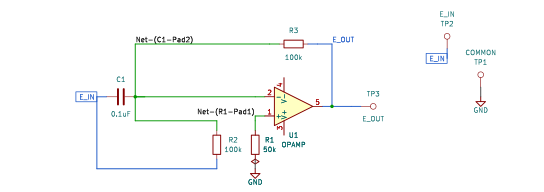
The schematic is drawn by copperhead’s
drafting engine from this circuit’s netlist, with KiCad’s own library symbols,
and it opens in KiCad as figure/augmented_differentiator.kicad_sch.
The op amp is KiCad’s generic one, since the handbook’s are ideal, and each
terminal is a test point named as the program names it. KiCad reads back from
the sheet exactly the connections the circuit has; draw_figures.py refuses to write
one that does not.
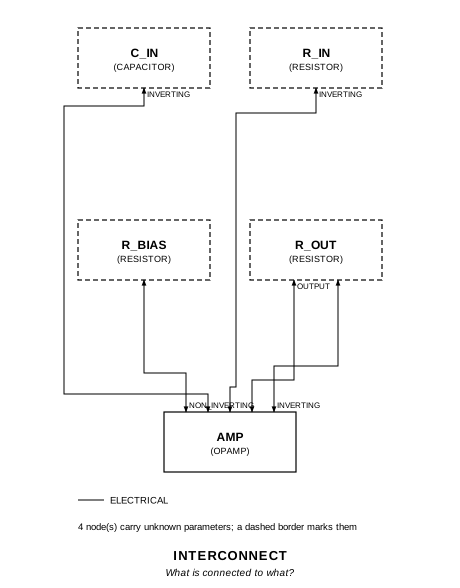
The interconnect view is fang’s own projection. It names the parts as the program does, so it reads against the code below.
What the program says
Section titled “What the program says”R_I makes an inverting amplifier of gain a_dc = -R_O/R_I = -1, C_I a
differentiator of time_constant = R_O C_I = 10 ms, and the summing point adds
them. In frequency terms E_O/E_I = -(1 + j 2π f × 10 ms): the two terms are
equal at f_equal = 1/(2π R_I C_I) = 15.9 Hz.
R2 is bias compensation, the DC resistance the - input sees, and the program holds it to that:
require(equals(self.r_bias.resistance, parallel(r_i, r_o)))The bench’s op amp has no bias current, so the simulation shows only that R2 does no harm. The figure gives every value, so nothing was chosen.
What the simulation found
Section titled “What the simulation found”out/simulation.txt, from the decks under
out/spice/:
| Run | Measured | Claimed |
|---|---|---|
input_term, E_I = 1 V DC | -1 | -1 (a_dc), holds |
both_terms, gain at 1 Hz | 1.002 | |1 + j 0.063| = 1.002, holds |
both_terms, gain at 15.9 Hz | 1.414 | |1 + j| = 1.414, holds |
both_terms, phase at 15.9 Hz | -2.356 rad | -3π/4, holds |
both_terms, gain at 159 Hz | 10.05 | |1 + j 10| = 10.05, holds |
peak, where the output turns real | 12.62 kHz | not a claim |
peak, height | 107.6 dB | not a claim |
The page does not mention it, but the derivative term has no stop, so this circuit shares the plain differentiator’s peak where its rising noise gain meets the op amp’s roll-off, near √(10 MHz × 15.9 Hz) = 12.6 kHz. A practical version would need the same stop as the circuits above it.
Running it
Section titled “Running it”fang check examples/ti_opamp_handbook/differentiators/augmented_differentiator/augmented_differentiator.pypython examples/regenerate.py ti_opamp_handbook/differentiators/augmented_differentiator # needs ngspiceThe whole program
Section titled “The whole program”"""The augmented differentiator, SBOA092B page 62.Show 22 more lines
E_O = -(R_O/R_I) E_I - R_O C_I dE_I/dt = -E_I - (1/100) dE_I/dt
C_I and R_I sit side by side between E_I and the summing point, and R_O runsfrom the output back to it. R_I makes an inverting amplifier of gain-R_O/R_I = -1, C_I a differentiator of time constant R_O C_I = 10 ms, and thesumming point adds the two currents: "sums input and its derivative". Infrequency terms the gain is -(1 + j 2 pi f 10 ms), flat at 1 up to1/(2 pi 10 ms) = 15.9 Hz and a derivative above it.
R2, 50 kOhm from the + input to ground, carries no signal. It is R_I inparallel with R_O, the resistance the - input sees to ground at DC, so thetwo input bias currents drop the same voltage and cancel. The program holds itto that rule. The bench's op amp has no bias current, so the simulation cannotshow what R2 is for; it shows only that R2 does no harm.
The derivative has no stop, so this circuit shares the plain differentiator'speak near 12.6 kHz, where its rising noise gain meets the op amp's roll-off.The page does not mention it; the bench measures it, and does not claim it.
The figure gives every value, so nothing was chosen."""
import sysfrom pathlib import Path
# The handbook's shared parts and bench live in the folder above the sections.sys.path.insert(0, str(Path(__file__).resolve().parents[2]))
from decimal import Decimal
from fang.lang import Hz, Parameter, System, kOhm, ms, require, uFfrom fang.parts import Capacitor, Resistorfrom fang.rationale import Citesfrom fang.simulation import ACSweep, OperatingPoint
from handbook import ( Bench, Claim, Ground, OpAmp, Run, Terminal, corner, equals, negative, over, parallel, product, ratio, within,)
class AugmentedDifferentiator(System): """E_I through C_I and R_I side by side into the summing point, R_O back."""
figure = Cites( "E_O = -R_O E_I / R_I - R_O C_I dE_I/dt; E_O = -E_I - (1/100) dE_I/dt. " "Sums input and its derivative", document="SBOA092B, Handbook of Operational Amplifier Applications", locator="page 62, Augmented Differentiator", )
a_dc = Parameter("1", default=-1 * ratio, description="-R_O / R_I, the E_I term") time_constant = Parameter( "s", default=10 * ms, description="R_O C_I, the dE_I/dt term: 1/100 s" ) f_equal = Parameter( "Hz", default=Decimal("15.9155") * Hz, description="1/(2 pi R_I C_I): where the two terms are equal", )
e_in = Terminal() common = Terminal() e_out = Terminal() c_in = Capacitor(capacitance=Decimal("0.1") * uF) r_in = Resistor(resistance=100 * kOhm) r_out = Resistor(resistance=100 * kOhm) r_bias = Resistor(resistance=50 * kOhm) amp = OpAmp() ground = Ground()
def architecture(self): self.e_in.probe >> self.c_in.p1 self.e_in.probe >> self.r_in.p1 self.c_in.p2 >> self.amp.inverting.signal self.r_in.p2 >> self.amp.inverting.signal self.amp.inverting.signal >> self.r_out.p1 self.r_out.p2 >> self.amp.output.signal self.amp.output.signal >> self.e_out.probe self.amp.non_inverting.signal >> self.r_bias.p1 self.r_bias.p2 >> self.ground.node self.common.probe >> self.ground.node
def constraints(self): r_i, c_i, r_o = self.r_in.resistance, self.c_in.capacitance, self.r_out.resistance require(equals(self.a_dc, negative(over(r_o, r_i)))) require(equals(self.time_constant, product(r_o, c_i))) # The two terms meet where C_I's reactance equals R_I. require(within(self.f_equal, corner(r_i, c_i), 0.00001)) # Bias compensation: the + input sees what the - input sees at DC. require(equals(self.r_bias.resistance, parallel(r_i, r_o)))
BENCH = Bench( page=62, title="Augmented Differentiator", runs=[ Run( "input_term", OperatingPoint(), drive={"e_in": "DC 1"}, measure={"gain": "v({e_out.1}) / v({e_in.1})"}, claims=[Claim("gain", "a_dc", within=0.001, note="At DC the derivative is zero and only -E_I is left")], ), Run( "both_terms", ACSweep(points=100, start="1", stop="1k"), drive={"e_in": "DC 0 AC 1"}, measure={ "gain_equal": "find vm({e_out.1}) at=15.9155", "phase_equal": "find vp({e_out.1}) at=15.9155", "gain_159": "find vm({e_out.1}) at=159.155", "gain_1": "find vm({e_out.1}) at=1", }, claims=[ Claim("gain_equal", 1.41421, within=0.001, note="|1 + j| at f_equal: the two terms equal and 90 degrees apart"), Claim("phase_equal", -2.35619, within=0.001, note="-3 pi/4 radians: -(1 + j), inverted and 45 degrees ahead"), Claim("gain_159", 10.0499, within=0.001, note="|1 + j 10| a decade up, where the derivative dominates"), Claim("gain_1", 1.00197, within=0.001, note="|1 + j 2 pi 1 Hz 10 ms|: at 1 Hz, nearly E_I alone"), ], note=( "The page's E_O = -E_I - (1/100) dE_I/dt, in frequency terms: " "E_O/E_I = -(1 + j 2 pi f x 0.01 s)." ), ), Run( "peak", ACSweep(variation="lin", points=2401, start="12k", stop="13.2k"), drive={"e_in": "DC 0 AC 1"}, measure={ "f_peak": "when vi({e_out.1})=0", "gain_peak_db": "max vdb({e_out.1})", }, units={"f_peak": "Hz", "gain_peak_db": "dB"}, note=( "Not a claim of the page. The derivative has no stop, so the " "noise gain rises like the plain differentiator's and meets the " "10 MHz op amp's roll-off near sqrt(GBW x 15.9 Hz) = 12.6 kHz." ), ), ],)The files it writes
Section titled “The files it writes”The parts, then the nets and the pads on them.
C1 0.1 uF -GND1 Ground -R1 50 kOhm -R2 100 kOhm -R3 100 kOhm -TP1 Terminal -TP2 Terminal -TP3 Terminal -U1 OpAmp -Net-(C1-Pad1) C1.1 R2.1 TP2.1Net-(C1-Pad2) C1.2 R2.2 R3.1 U1.IN-Net-(GND1-Pad1) GND1.1 R1.2 TP1.1Net-(R1-Pad1) R1.1 U1.IN+Net-(R3-Pad2) R3.2 TP3.1 U1.OUTEvery check that ran, and every one left undecided.
4 checks, 0 failed, 0 undecidedWhat the elaborated graph contains, by entity kind.
1 block 9 component 20 connection 4 constraint 1 evidence 3 interface 15 pin 15 port 68 totalsnapshot sha256:8f80c31ca51cdfe192801f0aeabced58d61cbe27cb274ce9d1985451258e4fd7All of it, including the KiCad netlist, is in
examples/ti_opamp_handbook/differentiators/augmented_differentiator/out/. Rebuild it with:
fang build examples/ti_opamp_handbook/differentiators/augmented_differentiator/augmented_differentiator.py