
Examples / TI op amp handbook / Buffers
Inverting buffer adjustable gain
SBOA092B page 50, Inverting Buffer Adjustable Gain: EI through RI (10 kΩ), a 100 Ω potentiometer and RO (10 kΩ) in a row to the output, with the pot's wiper on the inverting input.
The handbook prints no formula. The drawing’s, with s the wiper’s position from the R_I end:
E_O / E_I = -(R_O + (1 - s) R_2) / (R_I + s R_2)The circuit
Section titled “The circuit”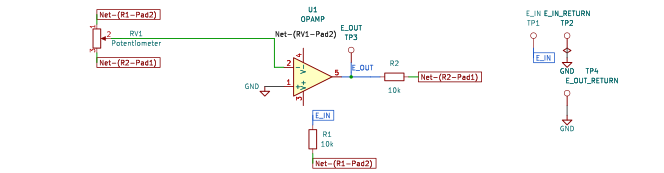
The schematic is drawn by copperhead’s
drafting engine from this circuit’s netlist, with KiCad’s own library symbols,
and it opens in KiCad as figure/inverting_buffer_adjustable_gain.kicad_sch.
The op amp is KiCad’s generic one, since the handbook’s are ideal, and each
terminal is a test point named as the program names it. KiCad reads back from
the sheet exactly the connections the circuit has; draw_figures.py refuses to write
one that does not.
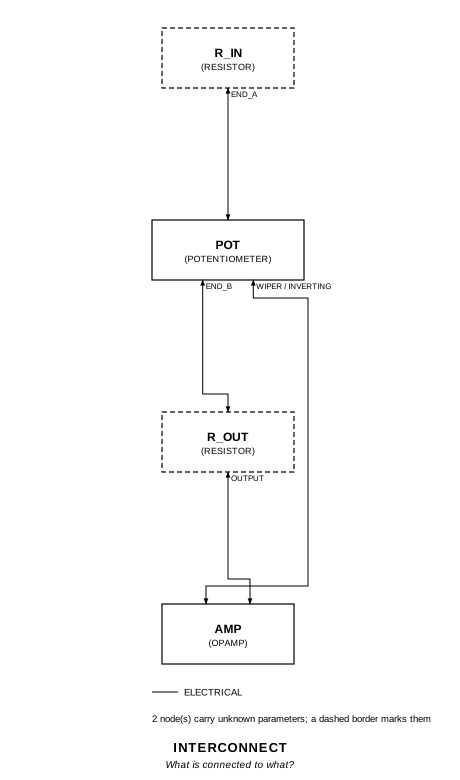
The interconnect view is fang’s own projection. It names the parts as the program does, so it reads against the code below.
What the program says
Section titled “What the program says”The figure leaves the wiper’s position open, so the program records a choice
(trim): the centre, where both sides are 10.05 kΩ and the gain is exactly
-1 (a_v). Two more parameters hold the ends of the trim: -1.01 with the
wiper at the R_I end (a_v_input_end) and -0.990099 at the R_O end
(a_v_output_end). All three are tied to the parts by the same function of
the pot’s setting, so a different pot or resistor fails the check.
What the simulation found
Section titled “What the simulation found”| Run | Pot setting | Measured | Claimed |
|---|---|---|---|
centre | 0.5 | -1 | -1 (a_v), holds |
wiper_at_input_end | 0 | -1.01 | -1.01 (a_v_input_end), holds |
wiper_at_output_end | 1 | -0.9901 | -0.990099 (a_v_output_end), holds |
A 100 Ω pot between two 10 kΩ resistors trims the gain by about ±1%, which covers the mismatch of two 0.5% resistors.
Running it
Section titled “Running it”fang check examples/ti_opamp_handbook/buffers/inverting_buffer_adjustable_gain/inverting_buffer_adjustable_gain.pypython examples/regenerate.py ti_opamp_handbook/buffers/inverting_buffer_adjustable_gain # needs ngspiceThe whole program
Section titled “The whole program”"""The inverting buffer with adjustable gain, SBOA092B page 50.Show 16 more lines
E_O / E_I = -(R_O + (1 - s) R_2) / (R_I + s R_2)
An inverter of gain -1, with a 100 Ohm potentiometer between R_I and R_O andits wiper on the - input. Where the wiper sits decides how much of the pot ison the input side and how much on the feedback side, so the gain can betrimmed a little either way of -1, which is what the text says it is for:making up for the tolerance of two 10 kOhm resistors.
The handbook prints no formula. The one above is the drawing's, with s thewiper's position from the R_I end. At the centre both sides are 10.05 kOhmand the gain is exactly -1; at the ends it is -10100/10000 = -1.01 and-10000/10100 = -0.990, a trim of about +/-1%. The figure leaves the wiper'sposition open, so `trim` records the centre as the setting the programclaims, and the bench turns the pot to each end."""
import sysfrom decimal import Decimalfrom pathlib import Path
# The handbook's shared parts and bench live in the folder above the sections.sys.path.insert(0, str(Path(__file__).resolve().parents[2]))
from fang.lang import Ohm, Parameter, System, kOhm, requirefrom fang.parts import Resistorfrom fang.rationale import Chooses, Citesfrom fang.simulation import OperatingPoint
from handbook import ( Bench, Claim, Ground, OpAmp, Potentiometer, Run, Terminal, equals, minus, negative, over, product, ratio, total, within,)
def gain(r_in, r_out, pot, setting): """-(R_O + (1 - s) R_2) / (R_I + s R_2), for a wiper at s from the R_I end.""" return negative( over( total(r_out, product(minus(1 * ratio, setting), pot)), total(r_in, product(setting, pot)), ) )
class InvertingBufferAdjustableGain(System): """R_I, the pot, R_O in a row from E_I to E_O; the wiper on the - input."""
figure = Cites( "Potentiometer in feedback allows gain trimming to compensate for " "tolerance in resistor values.", document="SBOA092B, Handbook of Operational Amplifier Applications", locator="page 50, Inverting Buffer Adjustable Gain", )
trim = Chooses( "Where is the wiper?", selected="at the centre of its travel, where the gain is exactly -1", alternatives=[ { "option": "at either end", "reason": ( "the ends are the trim's limits, not a setting anyone " "would leave it at; the bench runs both to show the range" ), }, ], rationale=( "the figure draws the wiper and gives no setting", "with matched 10 kOhm resistors the centre is where the trim lands", ), )
a_v = Parameter("1", default=-1 * ratio, description="E_O / E_I at the pot's setting") a_v_input_end = Parameter( "1", default=Decimal("-1.01") * ratio, description="the wiper at the R_I end" ) a_v_output_end = Parameter( "1", default=Decimal("-0.990099") * ratio, description="the wiper at the R_O end" )
e_in = Terminal() e_out = Terminal() e_in_return = Terminal() e_out_return = Terminal() r_in = Resistor(resistance=10 * kOhm) pot = Potentiometer(resistance=100 * Ohm, setting=Decimal("0.5") * ratio) r_out = Resistor(resistance=10 * kOhm) amp = OpAmp() ground = Ground()
def architecture(self): self.e_in.probe >> self.r_in.p1 self.r_in.p2 >> self.pot.end_a self.pot.wiper >> self.amp.inverting.signal self.pot.end_b >> self.r_out.p1 self.r_out.p2 >> self.amp.output.signal self.amp.output.signal >> self.e_out.probe self.amp.non_inverting.signal >> self.ground.node self.e_in_return.probe >> self.ground.node self.e_out_return.probe >> self.ground.node
def constraints(self): r_in, r_out, pot = self.r_in.resistance, self.r_out.resistance, self.pot.resistance require(equals(self.a_v, gain(r_in, r_out, pot, self.pot.setting))) require(equals(self.a_v_input_end, gain(r_in, r_out, pot, 0 * ratio))) # -10000/10100 does not end; six figures of it. `within` takes its # band as a fraction of the target, so it is written on the magnitudes. require( within( negative(self.a_v_output_end), negative(gain(r_in, r_out, pot, 1 * ratio)), 1e-6, ) )
BENCH = Bench( page=50, title="Inverting Buffer Adjustable Gain", runs=[ Run( "centre", OperatingPoint(), drive={"e_in": "DC 1"}, measure={"gain": "v({e_out.1}) / v({e_in.1})"}, claims=[Claim("gain", "a_v", within=0.0001)], ), Run( "wiper_at_input_end", OperatingPoint(), drive={"e_in": "DC 1"}, settings={"pot": {"setting": 0}}, measure={"gain": "v({e_out.1}) / v({e_in.1})"}, claims=[Claim("gain", "a_v_input_end", within=0.0001)], note="All 100 Ohm on the feedback side: the most gain the trim gives.", ), Run( "wiper_at_output_end", OperatingPoint(), drive={"e_in": "DC 1"}, settings={"pot": {"setting": 1}}, measure={"gain": "v({e_out.1}) / v({e_in.1})"}, claims=[Claim("gain", "a_v_output_end", within=0.0001)], note="All 100 Ohm on the input side: the least.", ), ],)The files it writes
Section titled “The files it writes”The parts, then the nets and the pads on them.
GND1 Ground -R1 10 kOhm -R2 10 kOhm -RV1 Potentiometer -TP1 Terminal -TP2 Terminal -TP3 Terminal -TP4 Terminal -U1 OpAmp -Net-(GND1-Pad1) GND1.1 TP2.1 TP4.1 U1.IN+Net-(R1-Pad1) R1.1 TP1.1Net-(R1-Pad2) R1.2 RV1.1Net-(R2-Pad1) R2.1 RV1.3Net-(R2-Pad2) R2.2 TP3.1 U1.OUTNet-(RV1-Pad2) RV1.2 U1.IN-Every check that ran, and every one left undecided.
3 checks, 0 failed, 0 undecidedWhat the elaborated graph contains, by entity kind.
1 block 9 component 18 connection 3 constraint 1 decision 1 evidence 3 interface 15 pin 15 port 66 totalsnapshot sha256:e8443e2d26240564d445c4eb95ebd5e1ee415242ce97f4bed60fb11570de7383All of it, including the KiCad netlist, is in
examples/ti_opamp_handbook/buffers/inverting_buffer_adjustable_gain/out/. Rebuild it with:
fang build examples/ti_opamp_handbook/buffers/inverting_buffer_adjustable_gain/inverting_buffer_adjustable_gain.py